
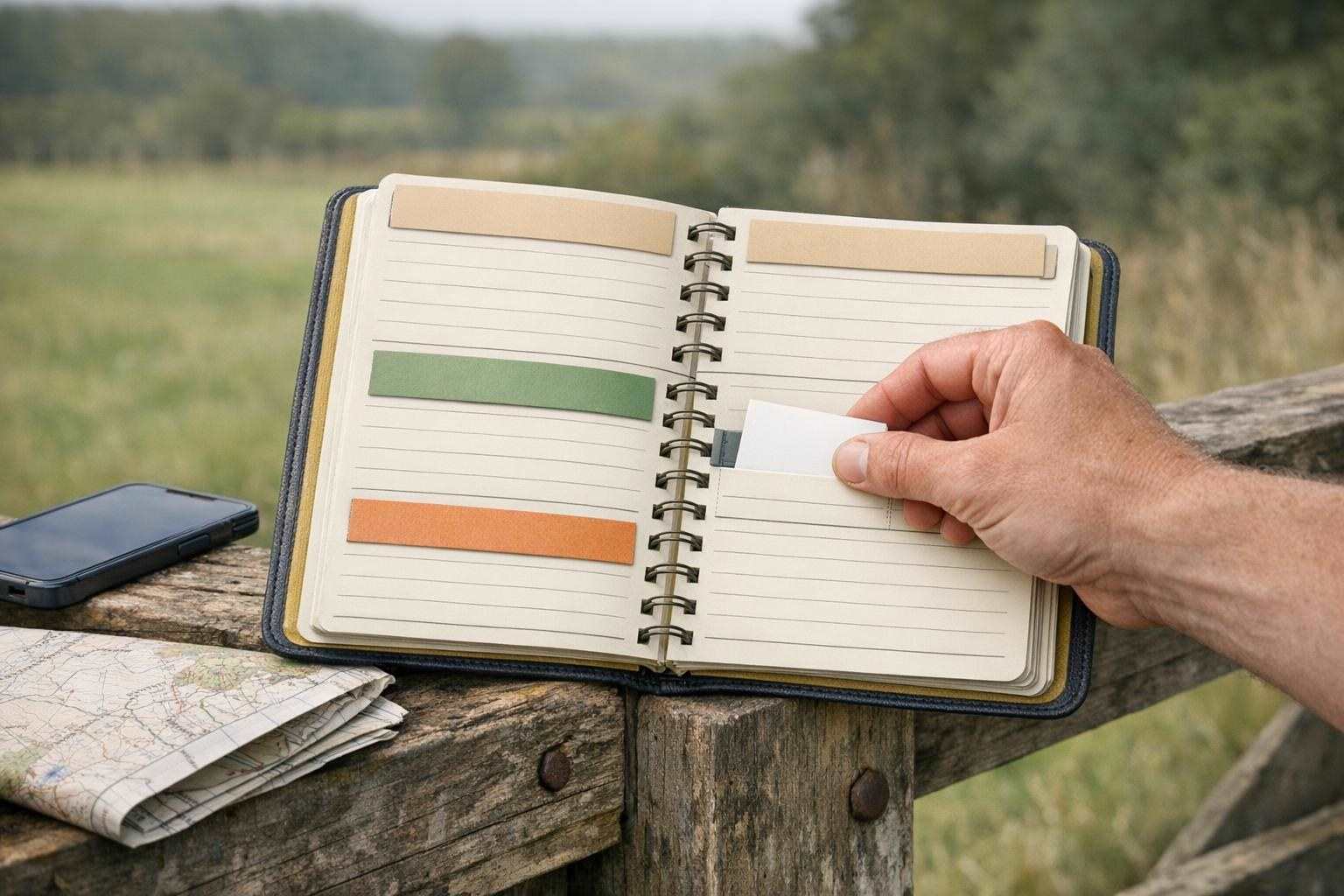
Organizing Landowner Contact Details Before the Next Hunting Season
Having a permission conversation in spring is easy to remember but surprisingly hard to reconstruct for the next season. It is easy to have a Gate Detail stored in some old text message, and access for a single property is often discussed in great detail but the landowner's plans for the property (and therefore the permission) may have changed greatly since last season. Setting up a simple contact system for permission conversations is very easy to set up and does not have to become 'work' to record all the conversations. The aim of such a system is to store information on who to contact and what was agreed to and what needs checking before you go out.
Start with the messy information you already have
Start with the information you already have – all the notes, texts, emails, paper, etc. Start with your phone contacts, your text messages, your emails, your notes, your maps, your calendar entries. Try to gather all of this information together first and start building from what you already have. The first pass through the information will reveal the 'holes' and 'inconsistencies' in your records.
You may have recorded a person's full name in your phone but referred to them by a nickname in your notebook. Likewise, a parcel of land may have been referred to by the name of the nearest road, a family name or even by a description of a field that only holds meaning for that hunter who has walked the ground. Use all of these to help cross reference but choose the one most suitable as the consistent 'label' for each property.
A useful record should answer basic questions quickly:
– Who has given permission to access land for hunting and how can they be contacted?
– Which property or portion of a property does the agreement cover?
– What kind and amount of access was granted for which seasons?
– Is there someone else the permission holder needs to be informed of prior to your arrival?
– What details still need confirmation?
Marking an entry as 'needs confirmation' is a lot better than risking an inaccurate assumption and entering that. It reminds you what needs to be done before you head out.
Separate people, properties and permissions
Many people organize their notes and records around the contact person for access to a property or group of properties. A better way to organize is to keep three different lists or sets of notes: one for each person you know who can grant permission for access to properties and for other activities on the land of that person.
For each contact: record full name, preferred method of contact and alternative method. For each property: record the agreed name of the property, a general location description and any details about entrances, car parks etc. and restrictions (e.g.presence of stock) on access at different times of year. Try to keep personal information to a minimum and keep a safe eye on how you are disseminating contact information in the file.
One of the most useful parts of your organizational notes on permission will be the record of what you actually agreed to with the landowner. That will include the name of the contact, what property or part of a property you have permission on to access for hunting, what type of access you have, for what time of year or for what length of time, and what other contacts need to be notified before you go. The detail of your permission is useful.
Additionally, these three types of information can be updated individually and therefore all changes are documented in detail. If for example a phone number changes, this only has to be updated in the contact information, whereas all other information regarding properties remains unchanged.
Build a pre-season check instead of relying on memory
Initially it is best to contact the owners of the oldest properties, with uncertain terms and conditions and where the accessibility of the land changes with the seasons due to farming, forestry etc. If you need to contact the owner before the season commences it is best to do so as early as possible and give the owner as much notice as possible, this will allow them to tell you that they are not willing to allow you to access the land, or to change the terms and conditions of your previous agreement.
Keep your questions very simple. Instead of saying, "We're planning on going out to your property for hunting on such-and-such a date," state your name, the property in question and note that you had previously discussed such permission for future dates and were wondering if that still applies. Also indicate if you will have anyone with you, if you will have a vehicle, if you need to cross any gates, or if you will be going out to retrieve game that has been shot on neighboring properties.
Remember to write down who you spoke to, on what date, to verify whether a confirmation is up to date or not. Any ambiguous responses should be cleared up with one more question, rather than risk a misunderstanding at a later date.
Your legal rights for the hunting of game (permission, access, the use of firearms, season) will be outlined in relevant legislation for each jurisdiction, and this should be checked before the season, and before you rely on any private agreement for access.
Make the access notes useful in the field
When accessing properties for hunting later in the season, having a few field notes recorded on the access notes for the related contact can be useful. Include the entrance to use, where to park, any Do Not Enter areas, such as fields with livestock, any equipment such as combines or tractors, notes on the gates, and any special requests such as filling in holes created by previous hunting trips. Keep these notes brief and factual.
Do not assume that marking a map pin for a property for which you have talked access, grants permission to access other lands that may join with the property shown by the map pin. Mark boundaries conservatively especially where parcels join together. The further you travel from the point where permission was granted the greater the uncertainty as to whether you are still on land for which you have permission to access. Be cautious and check with land owner before proceeding.
Even with notes on your phone, being without signal, having flat batteries or the App not working can present problems. Carry a small single printed page with crucial contact numbers, describe each property in full and note permission status. It is better to keep this sort of information on a few pages in secure storage rather than risk losing it all.
Decide what to archive, update or remove
Review all old season's access notes and mark each one as the following: confirmed for future discussion, inactive, expired or unclear. Old season's information should be separated from current access records but kept as the history to why a certain boundary or restriction is in place.
Delete duplicate phone numbers and outdated directions. If someone referred to you by a different name or you have used incorrect labels for properties etc. sort these out whilst the conversation is still fresh.
So long as a note is clearly understandable by another member of your group or club, then it does not matter whether that note is impressive or of no use whatsoever. Good hunting season preparation is essentially quiet work – the checking of contact details, confirmation of permission, the routing and the like.